
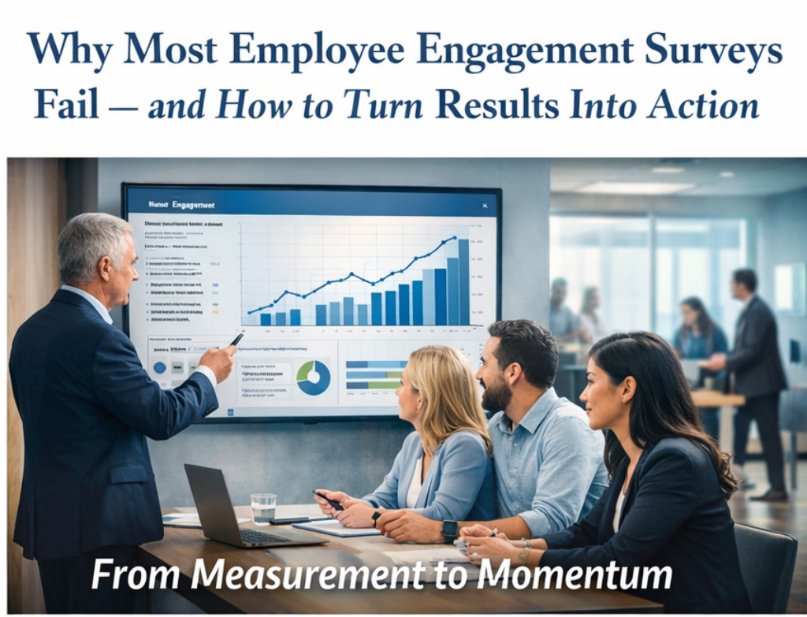
Getting meaningful employee engagement survey results is a critical business strategy—not just an HR initiative.
Employee engagement directly impacts retention, productivity, leadership effectiveness, and long-term organizational performance.
- For CEOs, it influences profitability and growth.
- For Operations leaders, it affects productivity, safety, and customer outcomes.
- For HR, it drives retention, culture, and workforce stability.
Yet despite widespread investment in engagement surveys, many organizations see little measurable improvement from year one to year two.
Why Engagement Surveys Fail
First, there is often a lack of trust in the process – Consequently if employees question confidentiality, candor declines. Data becomes diluted, and leaders act on incomplete insight.
Too Many Priorities – Organizations attempt to fix every low score at once. This creates initiative fatigue and diffuses accountability.
No Clear Ownership – When responsibility isn’t defined across executive, manager, and department levels, progress stalls.
Weak Communication – Employees rarely see what leadership is prioritizing — or how their feedback shaped decisions.
Without structure and follow-through, surveys become reporting exercises instead of performance strategies.
What Successful Organizations Do Differently
- Specifically, successful organizations ensure independent, confidential survey administration
- Identify statistically validated engagement drivers
- Align executives on 2–4 enterprise priorities
- Equip managers to lead structured team discussions
- Establish measurable commitments
- Track progress from year one to year two
- They focus on clarity, accountability, and sustained momentum.
Turning Insight Into Measurable Action
At SelectionLink, we guide organizations through the full engagement lifecycle.
Because we are a SHRM and Qualtrics Preferred Provider, we deliver more than survey distribution methods. For example we provide structure and strategic execution.
- Stakeholder interviews to align survey design with business priorities
- Access to hundreds of benchmarked survey questions
- Advanced driver analysis using Employee Engagement Index (EEI) and Employee Net Promoter Score (eNPS)
- AI-powered comment summarization with sentiment insights directly correlated to eNPS
- Executive presentations that clarify enterprise focus areas
- Manager discussion guides and communication templates
Most importantly, we narrow focus to a small number of high-impact priorities based on correlation analysis. When leaders commit to 2–4 strategic improvements — and communicate them clearly — employees see movement. And visible movement builds trust.
The Results of Disciplined Follow-Through
Organizations that embed accountability and structure into their engagement strategy see measurable gains.
SelectionLink clients achieve an average 6% increase in Employee Engagement Index (EEI) and 7% increase in Employee Net Promoter Score (eNPS) from year one to year two.
Measurable year-one-to-year-two results among SelectionLink clients include:
- A healthcare organization achieved a 7% increase in eNPS and a 5% increase in EEI in its second year.
- A hospitality company increased by 8% the number of employees who strongly agreed, “I rarely think about looking for another job.”
- A manufacturing firm realized a 9% year-over-year improvement in trust-in-leadership scores.
These improvements translate into reduced turnover risk, stronger workforce stability, increased advocacy, and improved operational performance.
Engagement becomes a strategic lever — not just a survey metric. Improve Engagement. Reduce Turnover. Strengthen Performance.
Discover how a confidential, full-service, third-party employee engagement survey partner can help your organization turn feedback into measurable results.
If you’re investing in engagement, make sure it delivers results.
SelectionLink helps organizations move from measurement to momentum — with structure, accountability, and measurable year-one-to-year-two improvement.